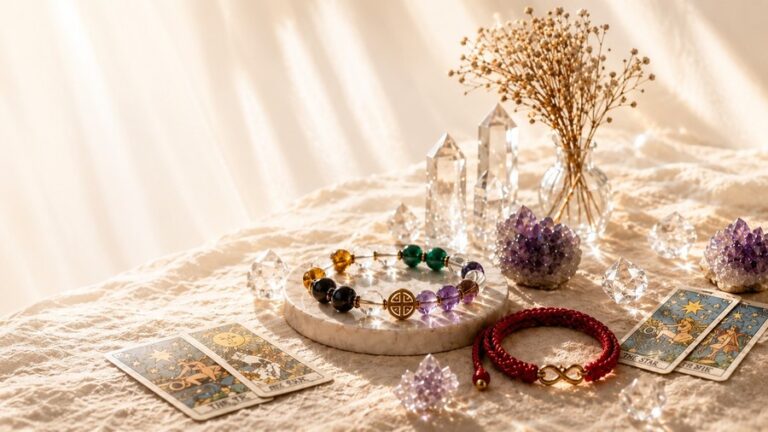
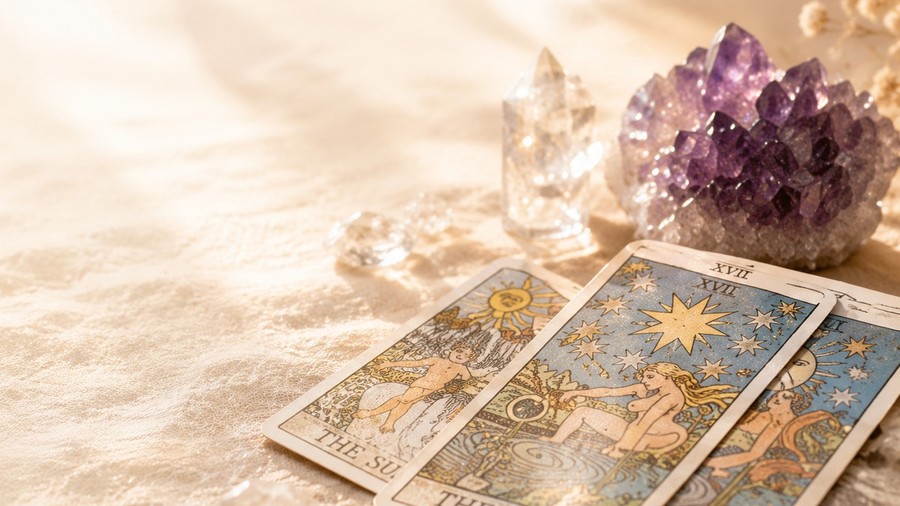
Morning sunlight streams through the window, hitting a crystal cluster and refracting tiny rainbows. I hold an amethyst in my palm, feeling its coolness spread across my skin. This is my ritual, my mindfulness practice—a few moments with these beautiful minerals before the day begins.
As someone with a rationally curious mind, I’ve found my attraction to crystals more complex than I initially understood. Is it their purported mystical energy? The mathematical beauty in their geometric structures? Or simply humanity’s innate draw to things that sparkle?
When Science Meets Legend
Geologically speaking, crystals are nothing more than solid minerals with orderly atomic arrangements. Formed deep within the Earth’s crust over millions of years under intense heat and pressure, they develop the perfect forms we admire. The piezoelectric effect in quartz crystals—generating an electric charge when under pressure—is indeed widely used in technology, from watches to smartphones.
Yet when people speak of crystal “energy,” they’re usually referring to another dimension: the intersection of culture, spirituality, and psychology.
Crystal Wisdom Across Cultures
Nearly every ancient civilization developed its own relationship with crystals:
Ancient Egyptians ground lapis lazuli into powder for eye treatments and viewed the stone as representing the heavens and divinity. China’s Shennong Bencao Jing documented crystals’ medicinal values. Tibetan monks used crystal balls for meditation and divination. Native Americans saw crystals as conduits for connecting with earth spirits.
Behind these traditions lies an ancient wisdom that connects natural forms, colors, and frequencies with human inner states.
The Modern Crystal Renaissance
During the 1970s New Age movement, crystal spirituality entered mainstream consciousness. People began systematically associating different crystals with specific intentions, emotions, and energy centers (chakras):
• Clear quartz served as a mental clarifier on desks
• Rose quartz accompanied those seeking love or self-acceptance
• Obsidian became an energy “shield” for sensitive individuals
• Citrine placed near cash registers symbolized abundance and flow
What Does Science Say?
Facing claims about crystal energies, the scientific community remains cautiously skeptical. No rigorous scientific studies prove crystals possess supernatural properties, yet this doesn’t negate their value entirely.
Psychology offers partial explanations:
The placebo effect is powerful—when we believe something brings peace, it often does. Focus rituals have inherent value—the act of selecting a crystal and setting an intention creates a psychological anchor. Tactile meditation—a crystal’s texture, temperature, and weight—grounds us in the present, away from anxious thoughts.
Neuroscience confirms that beautiful visual stimuli (like light refracted through crystals) do activate the brain’s pleasure centers.
My Personal Crystal Practice
Through my exploration, I’ve developed a “rational spirituality” approach—neither blindly believing nor completely dismissing:
1. As Intention Anchors
I choose crystals not by “shoulds” but by intuitive attraction. A crystal that calls to me on a particular day often reflects my current inner state. When tired, I naturally reach for darker, grounding stones; when needing creativity, brighter colors appeal.
2. Mindfulness Triggers
Carrying a crystal or keeping one on my desk creates gentle reminders to return to the present—to check my breath, pause the automatic thought cycle. These simple pauses often bring unexpected clarity.
3. Pure Appreciation of Beauty
Some crystal structures are so perfectly formed, their colors so pure, they become living lessons in geometry, optics, and color theory. Appreciating this natural artistry brings unexplained joy.
4. Symbolic Language
When choosing crystals as gifts, I’m offering symbolic blessings—an amethyst not as a “sleep aid” but as a physical representation of “I wish you peaceful rest.”
For the Curious Beginner
If crystals call to you, try this open-minded yet grounded approach:
Start with just one crystal—choose what simply appeals to you visually, without complex theories.
Cleanse and set intentions—rinse under water or place in moonlight while contemplating what quality you’d like it to represent (calm, courage, creativity). This process itself becomes a valuable psychological ritual.
Place it meaningfully—somewhere you’ll see it often: your workspace, bedside, meditation corner. Let it be a visual reminder, not an “energy device.”
Note your experiences—briefly record how you feel before and after interacting with your crystal. This self-observation holds more value than any external theory.
Maintain perspective—crystals are life enhancers, not solutions. True healing, success, and change still require real-world action and effort.
Beyond Binary Thinking
Perhaps the most fascinating discussion about crystals isn’t “is their energy real?” but why humans feel consistently drawn to these luminous objects.
Crystals may act as mirrors reflecting our own humanity—our longing for meaning, connection with nature, and anchors in an uncertain world. Their “energy” might be the vitality we project onto them, then reflect back to ourselves.
Next time you hold a crystal, feeling its cool temperature and unique texture, ask yourself: Is this stone affecting me, or am I, through it, touching some inner resource within myself?
In this overly digitalized, fast-paced era, perhaps we need various anchors—whether crystals, plants, art, or rituals—to remind ourselves to slow down, return to our senses, and reconnect with the physical world.
The clear quartz cluster on my desk casts tiny rainbows again in the late afternoon sun. I don’t know if this is quantum physics or energy healing, but I do know that when I pause to gaze at it, my breathing deepens, my shoulders relax, and my thoughts clarify. In a world full of complex questions, such simple moments themselves become precious energy exchanges.
Whether you purely appreciate crystals as natural art or deeply explore vibrational healing, they offer a fascinating gateway connecting the visible and invisible worlds. Ultimately, all external exploration may lead us back to the same starting point: a deeper understanding of our own inner landscapes.